

Programs and projects are at the heart of many business endeavors. To use a metaphor, projects are like trains operated by project managers, who help pull the work of a team to achieve goals and ultimately arrive with a finished good or service.
To continue with the metaphor, a program is like a collection of trains running on different tracks, yet headed to the same station, or goal. The program manager is the station conductor, directing the various project trains.
Projects have:
Programs have:
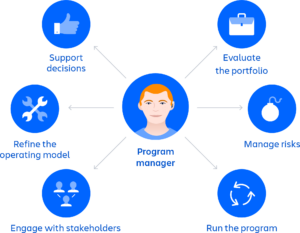
Program managers need to balance delivering artifacts, engaging with strategic decisions, managing stakeholders, and mitigating risks across the program. In a fully empowered organizational program, program managers should be able to solve — or connect to people who can solve — and plan to mitigate any problem that impacts the strategic initiative they seek to achieve.
Because of the breadth of their responsibilities, program managers play a key enabling role in companies. The role is flexible by design to meet the different challenges that teams encounter while going to production.
On any given day a program manager may do any of the following tasks:
Evaluate the state of the portfolio
A program manager reviews and evaluates a portfolio by connecting with teams to identify any risk mitigation or improvement opportunities. These connections can be coffee chats or team meetings. The program manager’s goal is to stay connected and engaged enough to work in lockstep towards shared goals. This includes connecting with project teams to ensure the project managers are supported and unblocked.
Manage risks
Risk management is a key element of portfolio management. Risks include a project timeline slipping, changing requirements, or the discovery of additional stakeholders. A program manager should be aware of anything that could impact the progress or outcome of the program and related projects. Ideally, a program manager can take corrective actions to reduce or manage risks in the portfolio.
Run the program
Program managers are responsible for running the program, which includes:
Engage with stakeholders
A program manager connects with stakeholders to get a sense of the wider context that surrounds goals. These conversations provide key insights into the overall landscape. By partnering with stakeholders, a program manager can help guide project teams.
Refine the operating model
The operating model shapes how teams progress toward their goals. This can include establishing communication channels and reporting methods, identifying goals, establishing priorities across the entire program. During the course of a program, a program manager optimizes the operating model to increase the likelihood of success and reduce the impact of risks.
Support decisions
Decision-making takes many forms, from running a meeting with decision-makers, to compiling background information on what decisions are needed, or doing a comparative analysis of multiple options. Specific program managers may lean into different areas, depending on their strengths. The program manager reviews outcomes to identify opportunities for improvement in systems, processes, or results.
The focus and scope of each program manager shape the specifics of how they engage with these practices.
A typical day for a project manager can include:
As you can see, program and project managers work on highly related tasks. The primary difference between these two roles is scope and ambiguity:
Read more: https://www.atlassian.com/agile/project-management/program-management